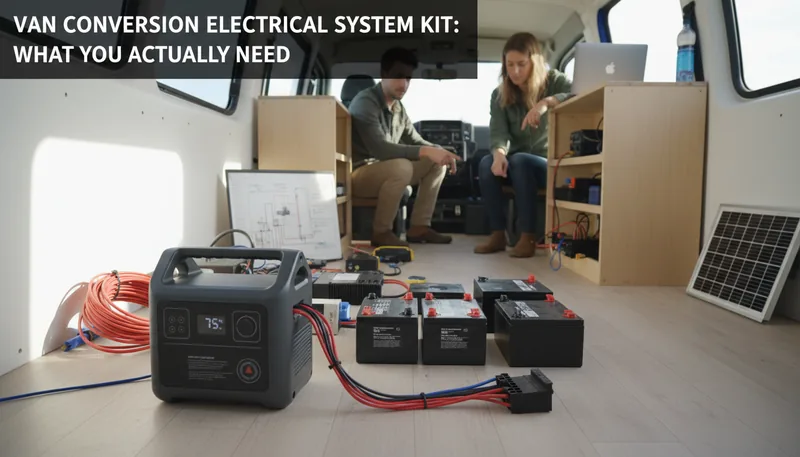
Van Conversion Electrical System Kit: What You Actually Need
A complete van conversion electrical system kit for a weekend van build centers on four items: a power station (also called a portable power bank) rated 2,000Wh or more, 200-400W of rooftop solar, MC4 and Anderson connectors, and a DC fuse block. Full-time van dwellers living 300+ days per year should weigh a fixed LiFePO4 installation instead. This guide gives you the itemized shopping list, the Wh sizing math, and specific product recommendations pulled from our database of 123 power stations.
1. How much power does your van actually need?
Start with this formula: total daily Wh = sum of (device watts x hours used per day). Then size your battery to hold 2x that number, because you should never drain LFP batteries below 20% state of charge.
Typical van life device load:
- Compressor fridge: 50W x 24h = 1,200Wh/day (the single biggest draw)
- Induction cooktop: 1,400W x 0.5h = 700Wh/day (weekend cooks only)
- Laptop: 60W x 6h = 360Wh/day
- Phone charging x2: 20W x 3h = 60Wh/day
- LED lighting: 30W x 5h = 150Wh/day
- Ventilation fan: 30W x 8h = 240Wh/day
- Water pump: 50W x 0.25h = 12Wh/day
A typical weekend build without the induction cooktop lands around 2,000Wh/day. Add the cooktop for cooking and you hit 2,700Wh/day. That means you need a battery rated 2,500-3,500Wh usable capacity to run through cloudy days without running dry.
For solar sizing: target at least 1.2x your daily Wh in panel watts, divided by your expected peak sun hours (4-5 hours in most of the continental US in summer). A 2,000Wh/day build needs 400-500W of panels. A standard Sprinter or Transit roof fits 2-4 panels at 175-200W each.
~1,200Wh/day
Compressor fridge daily draw
50W average x 24h; biggest single consumer in most van builds
~2,000Wh/day
Typical weekend van daily total
Fridge + laptop + lighting + fan + water pump, no induction cooking
2,500-3,500Whusable
Minimum battery capacity recommended
2x daily Wh to avoid deep discharge and absorb a cloudy day
400-500W
Solar panel wattage for 2,000 Wh/day
At 4-5 peak sun hours per day; accounts for shading and efficiency loss
2. The complete kit: must-have vs nice-to-have
MUST-HAVE items (your van does not function without these):
1. Power station (2,000-3,500Wh, LFP chemistry, 2,000+ cycle rating, 400W+ solar input, 1,000W+ AC continuous). This is the core of the system.
2. Solar panels (200-400W total for weekend builds; 400-600W for full-timers). Go with monocrystalline panels rated 175-200W each.
3. MC4 connectors and solar extension cables (10-20 feet from roof to station, 10AWG minimum). These connect panels to the power station's solar input port.
4. DC fuse block (6-12 circuit Blade-type, 30-100A main fuse). Protects each 12V circuit (fridge, fan, lights, water pump) individually. Blue Sea Systems and Victron make reliable options.
5. 8mm barrel cable or XT90 DC charging cable (if you want to charge from the van's alternator while driving). Most power stations accept 8mm or Anderson inputs.
6. Anderson SB50 connectors (for DC output connections to 12V loads outside the station's built-in outlets).
NICE-TO-HAVE items (add once the core system is running):
7. Battery shunt and monitor (Victron BMV-712 or similar, $80-$150). Tracks exact state of charge, current draw, and time-to-empty. Makes the whole system transparent.
8. 12V distribution panel (replaces the fuse block with a cleaner panel-mount solution; Blue Sea 360 Panel runs $100-$200).
9. Solar panel tilt/mounting brackets (adds 10-30% harvest at lower sun angles; $50-$120 for adjustable brackets).
10. Standalone AC inverter (only necessary if your power station's built-in inverter is insufficient; most 2,000-3,600W power stations cover all van life loads).
11. Shore power adapter (allows charging the power station from a campsite or marina 120V outlet via standard power cord).
Must-have items count6 items
Power station, panels, MC4 cables, fuse block, DC charge cable, Anderson connectors
Nice-to-have items count5 items
Battery monitor, distribution panel, panel tilts, inverter (if needed), shore power adapter
Solar cable gauge for roof runs10AWG minimum
For runs under 20 feet carrying up to 400W at 12-24V; use 8AWG for longer runs
DC fuse block main fuse30-100A
Size to the total amperage of all 12V circuits; label every circuit
3. Top power station picks for van conversions
Every product here is drawn from our van life activity rankings across 123 power stations. The key requirements: LFP battery chemistry (2,000+ cycles), at least 400W solar input, at least 1,000W AC continuous output, and a form factor that fits in a van cabinet (not over 60cm in any dimension ideally).
For van builds using the power station as the primary battery bank, the sweet spot is 2,000-3,500Wh. Under 1,500Wh runs short on cloudy days with a fridge. Over 4,000Wh becomes heavy and expensive for most weekend builds.
Undersized cables are the most common error. At 12V DC, every amp matters: a 50W fridge draws 4A, but an induction cooktop at 1,400W draws 117A at 12V. Run DC loads through the power station's built-in 12V outlets (typically fused to 10A each) or through a properly fused DC fuse block with cables rated to the circuit load. Never daisy-chain automotive butt splices for a permanent build.
The second common mistake is assuming the van's alternator can fast-charge a 3,000Wh power station while driving. Most power stations accept 8mm/DC charging inputs at 100-400W. At 200W alternator charging, a 3,000Wh station takes 15+ hours of driving to charge from empty. Solar is the primary charging source for van life; alternator charging is a supplement.
A third mistake is mismatching solar panels. Series-connected panels add voltage; parallel-connected panels add current. Your power station's MPPT input has a voltage window (typically 12-50V or 12-150V). Check the spec sheet before wiring panels in series. Two 200W panels wired in series at 40V open-circuit each produce 80V combined, which is above the 50V input limit on some stations.
Finally, many builders skip the battery monitor and then have no idea how much capacity remains. A $100 shunt (Victron BMV-712 or equivalent) tells you exactly how many amp-hours you have left, what current is flowing in or out, and how long until the battery is empty. This removes guessing and prevents accidental deep discharge.
Alternator charge rate (typical)100-400W
Via 8mm or DC charging cable; at 200W, a 3,000Wh station takes 15h of driving to fully charge
Induction cooktop DC current at 12V~117A
1,400W / 12V = 116.7A — must be powered via the station's AC inverter, not 12V DC outlets
Typical MPPT solar input voltage range12-50V (low-end) to 12-150V (high-end)
Check your station's spec sheet before wiring panels in series to avoid over-voltage
5. How to get the best value from your kit budget
The power station is the highest-cost single item and where you should concentrate your budget. At $0.39-$0.43/Wh for the top-ranked units, the 2,000-3,500Wh range delivers better cost-per-Wh than small 1,000Wh stations (which often run $0.60+/Wh). Sizing up from 1,000Wh to 2,000Wh typically adds only $200-$400 for double the capacity.
For solar panels, avoid proprietary brand-locked panel bundles sold by power station manufacturers. Generic monocrystalline panels (Renogy, Rich Solar, HQST) at $0.50-$0.70/W give the same output as branded panels at $1.50+/W. A 400W kit of four 100W panels costs $200-$280 versus $600+ for branded equivalents.
Buy MC4 connectors in pairs and cable by the foot from an electrical supplier rather than pre-made kits. A 20-foot 10AWG MC4 extension cable from a van conversion supplier runs $15-$25. Branded pre-made kits for the same run cost $50-$80.
For timing: power station prices drop 15-25% during Black Friday and Prime Day sales. If you are planning a spring or summer build, buying the power station in November or January and panels in February-March captures the best prices. The connectors and wiring hardware do not go on sale meaningfully, so buy those whenever convenient.
Budget tiers:
- Minimal weekend build: ~$1,250 (DJI Power 1000 V2 at $649 + 200W panels + cables)
- Standard weekend build: ~$2,000 (Dabbsson DBS2100 Pro at $829 + 400W panels + full kit)
- Full-time or near-full-time build: ~$3,000-$3,800 (Anker SOLIX F3000 at $1,299 or Dabbsson DBS3500 at $1,599 + 400-600W panels + monitoring)
Cost per Wh (top-ranked 2-3kWh stations)$0.39-$0.43/Wh
Dabbsson DBS2100 Pro at $829/2,150Wh = $0.39/Wh; better than small stations at $0.60+/Wh
vs $600+ for branded panel kits with identical electrical output
Typical sale discount on power stations15-25%
Black Friday and Prime Day are the two biggest discount windows each year
6. Power station vs fixed battery bank: which is right for your build?
This is the core decision for van conversion builders. A portable power station (portable power bank format) works well for weekend vans and part-time dwellers because it removes permanently, can be used in a hotel or at a worksite, and requires no 12V electrical certification knowledge to install. You set it on a shelf, run MC4 cables from the roof, plug in DC loads, and you are done in a day.
A fixed LiFePO4 battery installation (separate batteries, separate MPPT charge controller, separate inverter/charger, separate BMS) costs less per Wh at scale above 5,000Wh. At 10,000Wh, a fixed lithium bank with a Victron MultiPlus inverter-charger runs roughly $2,500-$3,500 in components versus $5,000-$8,000 for equivalent portable power stations. But installation adds $500-$2,000 in labor and materials if you hire it out.
For most builders reading this guide, the power station approach is the right call until you pass 4,000Wh and plan to live in the van 200+ days per year. At that threshold, a fixed system starts to pay back its complexity premium.
One hybrid approach: use a large power station (2,000-3,500Wh) as the main storage unit and add expansion batteries where the brand supports it. The Zendure SuperBase Pro 2000 and Dabbsson DBS3500 both support external battery expansion, effectively giving you a modular fixed-system experience without permanent wiring.
Break-even capacity for fixed vs portable~4,000-5,000 Wh
Below 4kWh, portable power stations are competitive on cost. Above 5kWh, fixed LiFePO4 banks become cheaper per Wh.
Fixed 10kWh LiFePO4 bank (components)$2,500-$3,500
For most van builds, you need a 2,000-3,500Wh LFP power station, 200-500W of solar, MC4 and Anderson connectors, and a DC fuse block. The Dabbsson DBS2100 Pro ($829) and Anker SOLIX F3000 ($1,299) are the strongest value options in our rankings. Full-timers doing 300+ days per year should evaluate a fixed LiFePO4 bank once capacity needs exceed 4,000-5,000Wh.
Most van lifers need 1,200-2,500Wh of usable capacity per day. A compressor fridge running 24/7 uses about 600Wh on its own. Add a laptop (480Wh/day), lights, fan, and water pump, and a daily total of 1,500-2,000Wh is typical. Size your battery to 2x daily Wh so you stay above 20% charge on cloudy days.