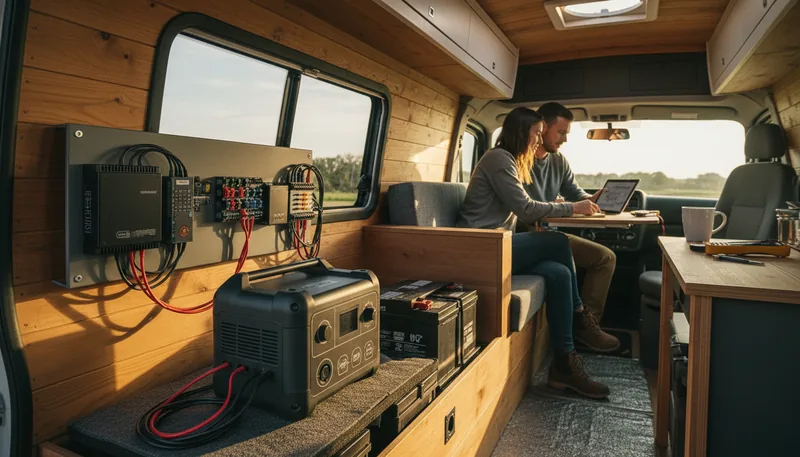
Van Conversion Electrical System Cost: Real Numbers for a Power-Station Build
A van conversion electrical system built around a portable power station costs $800 for a weekend-only build, $1,500-2,500 for a part-time live-in setup, and $3,000-4,500 for a full-time build with enough solar to stay off-grid indefinitely. Those numbers include the power station itself, solar panels, cables, fuses, and mounting hardware. Labor is extra if you hire out the install. This guide breaks each tier down line by line so you can plan a realistic budget before buying a single component.
1. How much power does a van build actually need?
Start with a daily watt-hour (Wh) budget before pricing any components. Every dollar you spend on the power station should be justified by a real device load.
A compressor fridge running 24 hours draws about 50W average, which is 1,200Wh per day. That single device accounts for the majority of consumption in most builds. Add a laptop (60W x 4h = 240Wh), LED lighting (30W x 4h = 120Wh), phone charging (20W x 2h = 40Wh), a ventilation fan (30W x 4h = 120Wh), and a water pump used briefly (50W x 0.5h = 25Wh). The total for a typical full-time van build lands around 1,745Wh per day.
For a weekend camper who runs the van only two days at a time, the math is simpler. Skip the fridge or use a smaller unit (30W average), drop lighting to an hour, and your daily draw falls to roughly 400-600Wh. A 1,000-1,500Wh portable power bank covers that with room to spare.
The formula: total daily Wh = sum of (device watts x hours per day). Round up by 20% for inverter efficiency losses. That number is your minimum capacity target.
1,200Wh/day
Compressor fridge
50W average draw, running 24 hours
240Wh/day
Laptop
60W x 4 hours of use
120Wh/day
LED lighting
30W x 4 hours
40Wh/day
Phone charging
20W x 2 hours
2. Three build tiers: itemized costs
Real costs depend on which products you buy, not theoretical minimums. The three tiers below use current market pricing from our database of 123 power stations, with solar and accessories priced from mainstream suppliers.
**Budget build (~$800 total):** This covers a weekend van that parks with shore power available most nights. Power station: $500-650 for a 1,000-1,100Wh unit. Solar: one 200W panel at $160-200. Cables and fuses: $80-120. Mounting: $40-60. No professional install needed for this tier. The DJI Power 1000 V2 (1,024Wh, $649) fits this tier with 2,600W AC output and 14.2kg weight.
**Mid-range build ($1,500-2,500 total):** The practical sweet spot for part-time van dwellers or couples doing 30+ nights per year. Power station: $829-1,299 for a 2,000-2,200Wh unit. Solar: 400W array at $320-480. Cables, fuses, and busbar: $150-250. Roof mounting brackets: $80-150. DIY install: free with 2-3 days of work; professional install: $300-500. The Dabbsson DBS2100 Pro (2,150Wh, $829) and DJI Power 2000 (2,048Wh, $1,099) sit squarely in this range.
**Full build ($3,000-4,500 total):** For full-time living with a fridge, induction cooktop use, and off-grid solar independence. Power station: $1,299-1,599 for 3,000-3,500Wh. Solar: 600-800W array at $500-900. Wiring kit with properly rated cables: $200-300. Professional roof penetration and weatherproofing: $400-800. The Dabbsson DBS3500 (3,430Wh, $1,599) and Anker SOLIX F3000 (3,072Wh, $1,299) are strong options here.
Budget build total~$800
1,000Wh station + 200W solar + wiring, weekend use
Mid-range build total$1,500-2,500
2,000-2,200Wh station + 400W solar + wiring + optional pro install
Full-time build total$3,000-4,500
3,000-3,500Wh station + 600-800W solar + full wiring + roof work
DIY install labor$0 (2-3 days)
Mid-range build; first-time builder
Professional install$300-800
Depends on complexity, roof penetrations, and cable runs
Not all 2,000Wh power stations are equal for van use. Van life activity scoring in our database weights five features heavily, and skimping on any of them creates a real problem down the road.
**Battery lifespan (minimum 1,500 cycles):** Daily cycling for a full-time van dweller means 365 cycles per year. A unit rated at 500 cycles lasts 16 months. A unit rated at 3,500 cycles lasts nearly 10 years. That difference more than justifies paying $200 more upfront. Our van-life requirements set 1,500 cycles as the floor.
**Max solar input (minimum 200W, ideally 400W+):** The power station's max solar input spec determines whether your roof array can actually keep up with daily consumption. A unit capped at 200W solar input accepts one 200W panel; one that accepts 800W can run a full roof array. For full-time builds, choose a unit with at least 400W solar input.
**AC power continuous (minimum 1,000W):** An induction cooktop draws 1,000-1,800W. A unit rated below 1,000W continuous cannot handle it. Most mid-range and full builds need at least 2,000W continuous to cook without tripping the inverter.
**Form factor (weight and dimensions):** A van has limited floor space. The Renogy Lycan 5000 (4,800Wh, 120kg) is technically a van-life power station but it occupies a significant portion of a cargo van's floor. Units in the 20-45kg range are more practical. The DJI Power 1000 V2 at 14.2kg is the lightest among top-10 van-life picks.
**Battery chemistry:** All top performers in van-life rankings use LFP (LiFePO4) cells. LFP tolerates deeper discharge cycles, handles heat better than NMC, and typically carries a longer warranty.
Min recommended cycle count1,500 cycles
From van-life activity requirements; daily cycling at 1 cycle/day = 4+ years
Min recommended solar input200W (floor), 400W+ (recommended)
Higher input = faster solar recharge; critical for off-grid days
Min AC continuous output1,000W
Required for induction cooktop; 2,000W+ handles most cooking appliances
4. Solar cost breakdown: panels, cables, and fuses
The solar component of a van electrical system is often underestimated. Beyond the panels themselves, you need the right cable gauge, proper fusing, and connectors that match your power station's solar input port.
**Panel types and pricing:** Rigid monocrystalline panels (200W each) cost $160-240 per panel and deliver the best efficiency per dollar. Flexible panels cost $180-280 for 200W but can be glued to a curved roof. Semi-flexible panels split the difference at $200-260 per panel. For most builds, rigid panels on a low-profile mounting rail are the right call.
**Cable sizing:** The cable from rooftop panels to your portable power bank runs through the van body, often 6-12 feet. Use AWG 10 wire for runs under 10 feet at 400W or less. For longer runs or higher wattage, step up to AWG 8. Under-sized cable wastes watts as heat and creates a fire risk. A pre-made MC4-to-XT90 cable (to match most power stations) costs $20-40; custom lengths with ring terminals run $30-80.
**Fusing:** Every solar installation needs an inline fuse between the panels and the station, sized 20-30% above the maximum expected current. For a 400W array at 36V, max current is about 11A; a 15A fuse is correct. Inline blade fuse holders cost $8-15. Do not skip this step.
**Charge controller note:** Every portable power bank on the market includes a built-in MPPT charge controller. You do not need an external controller. This is a meaningful cost advantage over a fixed battery bank, which requires a separate MPPT unit ($80-250).
Full solar component summary for a 400W mid-range build: two 200W panels ($320-480) + mounting rails ($60-120) + MC4 cables ($30-60) + inline fuse ($10-15) + weatherproof roof gland ($15-25). Total: $435-700.
200W rigid panel$160-240
Per panel; monocrystalline recommended
400W array (2 panels + hardware)$435-700
Includes mounting, cables, fuse, roof gland
600W array (3 panels + hardware)$600-950
For full-time builds needing 1,500+ Wh/day recharge
External MPPT controller$0 (built in)
All top power stations include MPPT — unlike fixed battery systems
5. Common mistakes that inflate van electrical costs
Builders consistently overspend or under-build by making the same errors. Our database of 123 power stations and the van-life context data point to three recurring patterns.
**Buying too little capacity and upgrading later:** A 1,000Wh unit at $650 followed six months later by a 2,000Wh unit at $900 costs more than buying the 2,000Wh unit first ($900). If you plan to live in the van part-time within two years, skip the budget tier and start at mid-range. The cost-per-Wh math punishes upgrades.
**Assuming 1,000Wh is enough for van life:** A compressor fridge alone uses about 600Wh per day in warm weather. Add a laptop, lights, and fan and you are already at the limit of a 1,000Wh station before a single charge cycle ends. Full-time use requires 2,000Wh minimum, and 3,000Wh+ is realistic if you cook with induction or work remotely with multiple devices.
**Ignoring solar connector compatibility:** Not all power stations accept the same connector type. Most accept MC4 directly, but some require an adapter (XT60, DC5525, or proprietary). A $15 adapter fixes this, but builders who do not check before buying end up with a panel array that does not connect to their station. Verify the solar input connector spec before purchasing panels.
**Skipping fusing on the solar run:** A short between the panel array and the station can push 20-30A through unprotected cable. In a van, that ignites insulation. An inline fuse costs $10. It is not optional.
**Choosing high cycle count over total system balance:** A 3,500-cycle station paired with 200W of solar still runs out of power after 1.5 cloudy days. Cycle count matters for longevity, but solar sizing matters for daily operation. Both need to be sized together.
Daily fridge draw~600 Wh/day
Compressor fridge at 50W average in warm weather
Upgrade cost penalty+$200-400
Typical loss when buying budget then upgrading vs buying mid-range first
Inline fuse cost$8-15
Non-optional; protects cable from short-circuit fire
6. How to get the best value: buying strategy by tier
Van conversion power costs have compressed over the past two years as more brands compete in the 2,000-3,500Wh range. Here is how to approach each tier without overpaying.
**Cost-per-Wh benchmarks (2026 pricing from our database):** Budget units (1,000-1,500Wh) average $0.55-0.75/Wh. Mid-range (2,000-2,200Wh) drops to $0.38-0.55/Wh. Full-size (3,000-5,000Wh) varies from $0.42-1.08/Wh depending on brand. The Dabbsson DBS2100 Pro at $0.39/Wh and the Anker SOLIX F3000 at $0.42/Wh represent the best value-per-Wh in the mid and full tiers respectively.
**When to buy:** Black Friday (November) and Amazon Prime Day (July) consistently produce 15-25% discounts on power stations from EcoFlow, Bluetti, and Anker. Dabbsson and Zendure run their own site sales on similar cycles. If your build is not time-critical, waiting for a sale on a mid-range unit can save $150-300.
**Fixed battery system vs. power station:** A fixed 200Ah LiFePO4 system (battery + BMS + 2,000W inverter + MPPT controller + shore charger + alternator charger + wiring) costs $1,800-3,500 before installation. A portable power station in the same capacity range costs $829-1,299 with no separate components required. The portable option (also called a portable power bank in the van community) is the cheaper path for builds under 200Ah equivalent (roughly 2,500Wh) unless you specifically need alternator charging integration.
**When a fixed system wins:** If you drive more than 4 hours per day and want to harvest alternator power, a fixed system with a DC-DC charger recovers 40-60Ah per driving hour. Most power stations support 12V car charging, but at 10-18A (120-216W), it is meaningfully slower than a dedicated DC-DC setup at 20-40A. Full-time drivers who cover long distances should run the fixed system math before committing to a power station build.
**Budget reallocation tip:** If your build budget is $2,000, spend $900-1,100 on the power station (the core asset), $500-600 on solar, $150-200 on wiring, and keep $300-400 in reserve for the items you forget: a battery-to-battery charger cable, a roof vent, or a spare fuse kit.
Budget tier cost-per-Wh$0.55-0.75/Wh
1,000-1,500Wh units; higher $/Wh but lower absolute cost
Mid-range cost-per-Wh$0.38-0.55/Wh
2,000-2,200Wh units; best Wh-per-dollar range
Fixed LiFePO4 system (comparable capacity)$1,800-3,500
200Ah bank with BMS, inverter, MPPT, shore charger — before install labor
A van conversion electrical system costs $800-4,500 depending on capacity and solar array size. The mid-range build (2,000-2,200Wh station + 400W solar + wiring kit at $1,500-2,500) hits the best cost-per-Wh value for part-time and weekend use. Size up to 3,000Wh+ only if you run a fridge full-time or cook with induction regularly.
A budget power-station build runs roughly $800 all-in: ~$650 for a 1,000Wh station, $180 for a 200W panel, and $80-120 for cables and fuses. A mid-range build with 2,000Wh capacity and 400W of solar costs $1,500-2,500. A full-time build with 3,000-3,500Wh and 600W+ solar lands at $3,000-4,500 before any professional install labor.