How to Choose a Power Station for Camping (2026 Guide)
Camping

How to Choose a Power Station for Camping (2026 Guide)

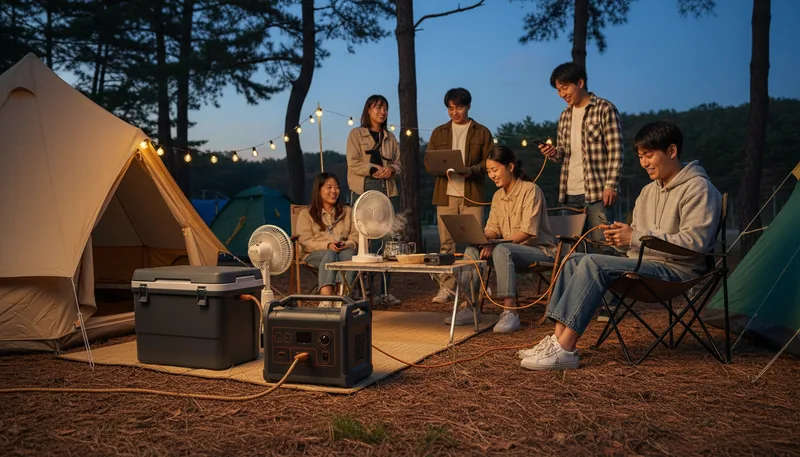
A camping power station lets you keep your phone charged, run an electric cooler, power a fan on hot nights, and watch movies on a laptop — all without a noisy generator. But picking the wrong size means either running out of juice at midnight or lugging a 38 kg brick to a campsite. This guide walks you through exactly how much power you need, which features matter for camping specifically, and which products scored highest on our database of 112 ranked power stations.

1. How Much Power Do You Need?

The key number is watt-hours (Wh) — how much total energy the battery holds. To calculate what you need, add up the wattage of every device you plan to run, multiply by the hours you'll use it, and that's your daily draw. For a typical car camping setup: a 60W electric cooler running 8 hours (480 Wh) + two phone charges at 20W for 1 hour (40 Wh) + a 30W fan for 6 hours (180 Wh) + a 60W laptop for 2 hours (120 Wh) = 820 Wh per day. Add 20-30% for efficiency losses and you need roughly 1,000 Wh for a comfortable weekend. If you only need phone charging and LED lights for a night or two, 300-500 Wh is enough and keeps weight under 5 kg.
60W
Electric cooler (typical)
8 hours overnight = 480 Wh
20W
Smartphone charging
2 full charges per phone per day
30W
Portable fan
6 hours = 180 Wh
60W
Laptop (streaming movies)
2 hours = 120 Wh

2. Key Features to Look For

For camping, weight and portability are the most important factors — more critical than raw capacity. A 3,000 Wh station that weighs 38 kg is miserable to carry from a parking lot to a campsite. Our camping activity scoring puts a weight_adjustment of 3.0 on both weight and portability, compared to 2.0 for capacity. Aim for under 10 kg if you hike more than 100 meters to your site, and under 20 kg for car camping where you wheel it right out of the trunk. Noise level matters too — the whole point of ditching a generator is the quiet. Look for units rated under 45 dB, which is quieter than a normal conversation. Solar input is a bonus for multi-day trips, but be realistic: under a tree canopy you'll get 30-50% of the rated solar input. Battery lifespan (cycle count) matters if you camp frequently — a unit with 3,000+ cycles will outlast one with 500 cycles by years of regular use.
Weight target (backpack camping)Under 5 kg
Lightest camping-capable units start around 1.9 kg at 256 Wh
Weight target (car camping)Under 20 kg
Most 1,000-2,000 Wh units fall in the 14-23 kg range
Noise level targetUnder 45 dB
Quieter than a whisper at 1 meter — campground-friendly
Solar input under canopy30-50% of rated
Shade reduces solar harvest significantly — plan accordingly

3. Our Top Picks for Camping

We scored 112 power stations across five camping-specific criteria: battery capacity, weight, portability, AC output, and noise level. The OUPES Mega 2 stands out as the best all-round camping pick — at 2,048 Wh and 22 kg for $679, it delivers enough power for a full weekend with an electric cooler and multiple devices, without breaking the bank. If you need maximum capacity and budget is secondary, the OUPES Mega 3 offers 3,072 Wh at 37.8 kg for $1,099. For lighter trips where you mostly need phone and laptop charging, the VTOMAN FlashSpeed 1500 hits the sweet spot at 1,548 Wh and 18.8 kg for $539.99. The EcoFlow DELTA 2 Max at $849 is a popular choice for frequent campers thanks to its 3,000-cycle battery lifespan and near-silent 30 dB operation.

4. Common Mistakes to Avoid

The biggest mistake campers make is assuming bigger is always better. A 3,000 Wh station sounds great until you're dragging 38 kg through a campground at dusk. Always calculate your actual daily watt-hour needs before buying — most weekend campers are surprised to find 600-1,000 Wh covers everything comfortably. The second common mistake is not accounting for cold weather. Standard lithium-ion batteries lose 20-30% of their rated capacity when temperatures drop below freezing. If you winter camp or camp in mountain elevations, factor in that buffer. LiFePO4 chemistry handles cold better and is the preferred choice for all-season use. Third: overestimating solar charging. If your campsite is under tree cover — which most forest and mountain sites are — expect to get only 30-50% of the panel's rated input. Bring enough battery capacity to cover at least one full day without any solar contribution.
Battery capacity loss in cold20-30%
Below 0°C (32°F) — LiFePO4 handles cold better than NMC lithium-ion
Solar under tree canopy30-50% of rated
Shade from trees reduces effective solar harvest dramatically

5. Sizing by Trip Type

Your trip style should drive your capacity decision more than anything else. For a solo overnight hike-in camping trip, you need 200-400 Wh — enough for phone charging and a small LED light. Units like the VTOMAN FlashSpeed 1000 at 1,000 Wh and 11 kg cover a couple with phones, a speaker, and a lantern for two nights. For a family car camping weekend (2-3 nights) with an electric cooler as the primary draw, 1,500-2,500 Wh is the target. The OUPES Mega 2 at 2,048 Wh and $679 is sized exactly for this use case. For week-long glamping or camp sites with power-hungry appliances like a portable air conditioner (roughly 600W), you'll want 3,000+ Wh and the ability to recharge via solar — look at the VTOMAN FlashSpeed Pro 3600 at 3,096 Wh, though note its 38 kg weight means it stays in one place.
Solo overnight hike-in200-400 Wh
Phone + lantern only — keep it light
Family car camping weekend1,500-2,500 Wh
Cooler + phones + fan + laptop = ~1,000 Wh/day
Extended glamping / week trip3,000+ Wh
Add portable AC (600W) and cooking appliances to the load

Summary: The Bottom Line

For most car camping trips, a 1,000-2,000 Wh power station weighing under 23 kg hits the sweet spot between capacity and portability. Prioritize weight and noise level over raw wattage, factor in 20-30% cold weather capacity loss if you camp in cooler conditions, and don't count on solar charging under tree cover. The OUPES Mega 2 ($679, 2,048 Wh) and VTOMAN FlashSpeed 1500 ($539.99, 1,548 Wh) are our top picks for the most common camping use cases.

Editor's choice
OUPES Mega 2
2500W$679

Frequently Asked Questions

For a typical car camping weekend with a phone, LED lantern, and small fan, 500-1,000 Wh is sufficient. Add an electric cooler running overnight and you need 1,500-2,000 Wh. Calculate your total daily watt-hours by multiplying each device's wattage by the hours you'll run it, then add 25% for efficiency losses.

Related Buying Guides